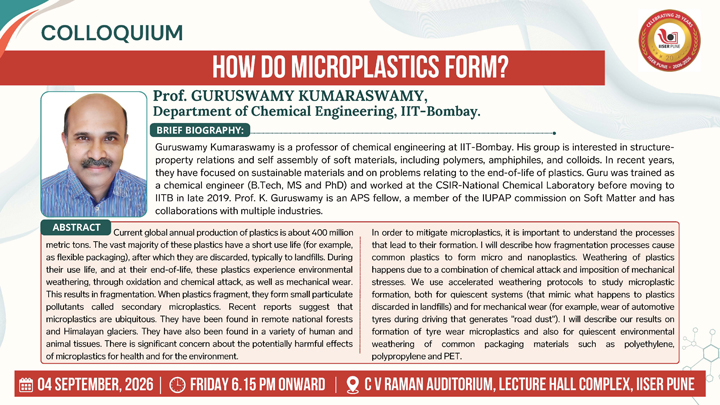
How do microplastics form?
C.V. Raman Auditorium, Lecture Hall Complex, IISER Pune campus
Abstract:
Current global annual production of plastics is about 400 million metric tons. The vast majority of these plastics have a short use life (for example, as flexible packaging), after which they are discarded, typically to landfills. During their use life, and at their end-of-life, these plastics experience environmental weathering, through oxidation and chemical attack, as well as mechanical wear. This results in fragmentation. When plastics fragment, they form small particulate pollutants called secondary microplastics. Recent reports suggest that microplastics are ubiquitous. They have been found in remote national forests and Himalayan glaciers. They have also been found in a variety of human and animal tissues. There is significant concern about the potentially harmful effects of microplastics for health and for the environment.
In order to mitigate microplastics, it is important to understand the processes that lead to their formation. I will describe how fragmentation processes cause common plastics to form micro and nanoplastics. Weathering of plastics happens due to a combination of chemical attack and imposition of mechanical stresses. We use accelerated weathering protocols to study microplastic formation, both for quiescent systems (that mimic what happens to plastics discarded in landfills) and for mechanical wear (for example, wear of automotive tyres during driving that generates "road dust"). I will describe our results on formation of tyre wear microplastics and also for quiescent environmental weathering of common packaging materials such as polyethylene, polypropylene and PET.
About the speaker:
Guruswamy Kumaraswamy is a professor of chemical engineering at IIT-Bombay. His group is interested in structure-property relations, and self assembly of soft materials, including polymers, amphiphiles and colloids. In recent years, they have focused on sustainable materials and on problems relating to the end-of-life of plastics. Guru was trained as a chemical engineer (BTech, MS and PhD) and worked at the CSIR-National Chemical Laboratory before moving to IITB in late 2019. Prof. K. Guruswamy is an APS fellow, a member of the IUPAP commission on Soft Matter and has collaborations with multiple industries.