


When Light Rewrites the Rules
For more than a century, scientists have relied on a simple principle to understand how light interacts with matter: the thicker a material, the more light it absorbs. This relationship, known as the Beer–Lambert law, underpins technologies ranging from chemical sensing and medical diagnostics to solar energy and photonics.
But what happens when a material is only a few atomic layers thick?
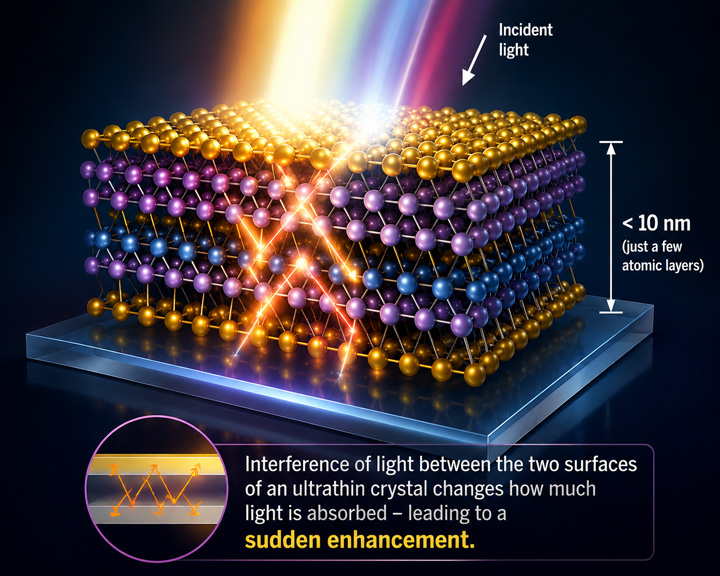
Dr. Ashish Arora's research group from the Physics Department of IISER Pune reported in a recent paper that in the ultrathin regime, light behaves very differently from what classical optics predicts. Their study shows that once a crystal becomes only a few tens of nanometres thick, the conventional Beer–Lambert law gradually begins to lose its predictive power. More strikingly, below about 10 nanometres—where the crystal is only a few atomic layers thick—light absorption undergoes a sharp anomalous enhancement rather than increasing smoothly with thickness. In layered semiconductors only a few nanometres thick, the deviation from the Beer–Lambert prediction can exceed 150 percent, revealing that one of optics' oldest and most widely used principles reaches its limits at the nanoscale.
The research was led by IISER Pune faculty member Dr. Ashish Arora. The optical experiments were performed by PhD researcher Bhumika Chauhan, while the theoretical modelling and analysis that uncovered the origin and universality of the effect were carried out by Bhumika Chauhan together with Master's thesis student Abhisek Saidarsan. Their combined experimental and theoretical work demonstrates that the phenomenon is not unique to a particular material but is a universal feature of solids.
"For over a century, we have taught that thicker materials absorb more light. Our work shows that when materials become ultrathin, nature follows a different rule. This discovery opens a new way of thinking about light–matter interactions at the nanoscale," said Dr. Arora.
"The anomalous enhancement arises not from exotic quantum effects but from the wave nature of light itself. As light reflects repeatedly within an ultrathin crystal, interference modifies how efficiently energy is absorbed. The finding has important implications for designing ultrathin solar cells, photodetectors and flexible optoelectronic devices, where accurate prediction of light absorption is crucial" said Dr. Arora.
The work has recently been accepted for publication as a Physical Review B Letter. A preprint of the study is also freely available on arXiv.
Citation:
Bhumika Chauhan, Nikhil Singh, Subhrajit Dalai, Abhisek Saidarsan, Sayantan Patra, Sourabh Jain, Aparna Deshpande, and Ashish Arora* (2026). Universal thickness-dependent absorption in solids at the nanoscale: Anomalous enhancement in the ultrathin limit. Phys. Rev. B 114, L111404.