Published in the Journal of Cell Science, this work from Prof. Nagaraj Balasubramanian’s group from the Biology Department of IISER Pune identifies a previous unknown link between stiffness of the matrix surrounding cancer cells and the organisation and function of Golgi Apparatus, a key cellular organelle. This work has appeared on the Cover Page of the journal and its lead authors Arnav Saha and Tushar Sherkhane were featured in the “First Person” section of the issue. The research article was also described in the "Research Highlight" feature of the journal.
Scientists have long observed that as breast cancer progresses, the tissues surrounding a tumour, referred to as the extracellular matrix, become stiffer, and found that this is critical to the spread of cancer. A new study by Prof. Nagaraj Balasubramanian’s group from the Biology Department of IISER Pune, published in the Journal of Cell Science, identified a previously unknown link between matrix stiffness and the organisation and function of a cellular organelle called Golgi apparatus in breast cancer cells. This finding is significant because it gives us a window into understanding how breast cancer cells respond to their microenvironment, and thereby into how cancer spreads.
The Golgi apparatus is known to be the processing centre of the cells, as it sorts and packages proteins and lipids for various destinations within and outside the cell. As newly minted proteins traverse through the stacks of the Golgi organelle, they undergo chemical modifications such as glycosylation that target them to different destinations and regulate their function. Thus the organisation (morphology) of the Golgi in cells is rather functional in nature.
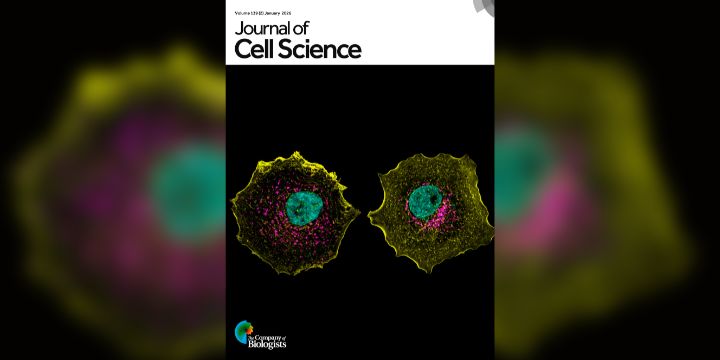
In the present study, the team found that in a highly invasive breast cancer cell type (MDA-MB-231 cells), increasing matrix stiffness induces progressive compaction and organization of the Golgi, and is accompanied by enhanced cell spreading. In contrast, non-invasive breast cancer cell type (MCF7 cells) maintained a predominantly dispersed or disorganized Golgi across stiffness levels, even though stiffness still promotes cell spreading.
The team found that a Golgi associated protein called AXL is involved in determining whether the Golgi organisation is responsive to matrix stiffness. The expression of AXL in these cells was also found to be sensitive to matrix stiffness. When the team targeted AXL in the invasive breast cancer cells, they found that stiffness-dependent Golgi organization was disrupted; and conversely, when AXL was added to the non-invasive breast cancer cell type, the Golgi organisation now became responsive to matrix stiffness.
The team further found that Arf1, a protein involved in cellular transport, Golgi organisation and linked to cancer cell progression, is part of the pathway that senses the matrix stiffness to regulate Golgi organisation and function.
“Our results establish a mechanotransduction pathway in which matrix stiffness is sensed through the AXL–Arf1–Golgi axis to regulate Golgi structure and function. This provides a mechanistic link between the tumour microenvironment’s mechanical properties and breast cancer aggressiveness,” described Prof. Balasubramanian. The team indicated that these findings have implications for how extracellular matrix-driven mechanical cues could promote invasion and metastatic behaviour via Golgi-mediated control of protein processing pathways in cells.
This research received funds from Anusandhan National Research Foundation (ANRF) (formerly the Science and Engineering Research Board (SERB)). PhD student Arnav Saha (funded by a PMRF fellowship) and BS-MS student Tushar Sherkhane (now an alumnus and doing PhD at ETH Zurich) carried out this work with guidance from Prof. Balasubramanian.
Citation:
Arnav Saha, Tushar Sherkhane, and Nagaraj Balasubramanian (2026). Differential AXL expression and Arf1 regulation control stiffness-dependent Golgi organization in breast cancer cells. Journal of Cell Science, 139(2): jcs263956. https://doi.org/10.1242/jcs.263956
- with inputs from Prof. Nagaraj Balasubramanian