The National Conference on Indian Knowledge System: Science and Technology (NCIKSST-2026) was held at IISER Pune on March 7, 2026. This was a unique event held on campus to bridge ancient Indian scientific wisdom with modern academic inquiry. The conference featured a packed schedule of five technical sessions, ten special lectures drawing participants from institutions across India.
The conference commenced with an inaugural session led by IISER Pune Director Prof. Sunil Bhagwat. In his address, Prof. Bhagwat emphasised India’s historical role as a global knowledge hub and India’s rise from a newly independent nation to its self-reliance in fields like food and industrial production.
Chief Guest Prof. M.D. Srinivas (from the Centre for Policy Studies) spoke on the topic of why we have to be proud about the Indian Knowledge System. "Being proud without knowing the ancestral knowledge may not be very useful,” he said. He took the examples of the mathematics of calculus and the astronomy of non-geocentric planetary model, both of which were developed in India two centuries before the developments elsewhere such as in Europe.
Shri Madabhushi Madan Gopal (Chairperson BoG, IISER Pune) highlighted the spiritual and patriotic roots of Indian Knowledge Systems (IKS), citing historical engineering feats like the Vijayanagara Tank Bunds and the irrigation techniques developed early on in India. He observed that the entire concept of Indian Knowledge is rooted in spirituality (anda-pinda-brahmada, yath pinde tat brahmande) highlighting the Microcosm-Macrocosm theory. He asked that we shed colonial hangover and claim back our confidence.
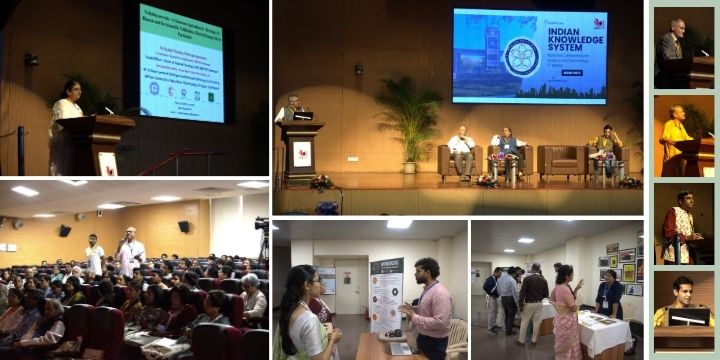
The talks that followed during the day were structured into three thematic sessions:
Ancient Indian Mathematics (Session 1): Prof. Amartya Kumar Dutta (ISI Kolkata), Prof. M.D. Srinivas (Centre for Policy Studies), and Prof. Anil Gourishetty (IIT Roorkee) provided glimpses into ancient Indian astronomy and mathematics, the sophisticated non-geocentric planetary models of the past, and the STEM studies in the field of IKS.
Prof. M.D. Srinivas gave an account on the seminal contributions of the Kerala School of Mathematics and Astronomy founded by Mādhava in the 14th century. Prof. Srinivas referred to Madhava’s infinite series for π and their proof as outlined in the renowned Malayalam text Yuktibhasa (c.1530) of Jyeṣṭhadeva. He pointed out that the revised planetary model proposed by Nīakaṇṭha Somayājī in 1500 is computationally a good approximation to the model proposed by Kepler in early 17th century.
Prof. Amartya Kumar Dutta presented a few landmarks from ancient Indian mathematics and said that these achievements that were ahead of their time deserve to be widely known among all Indians and academicians and intellectuals.
Prof. Anil Kumar Gaurishetty, mentioned that many have misconception that Sanskrit is an ancient or dead language, restricted only to scriptures and shlokas. He said that many old textbooks of science and mathematics were written in Sanskrit a few centuries ago. He highlighted the value of promoting Sanskrit and STEM in IKS so as to understand the contributions that many never heard of.
STEM-IKS Integration (Session 2): Lectures covered diverse topics from spectroscopic characterization of Hiṅgula to the sacred geometry and consciousness embedded in ancient temple architecture. Speakers in this session included Prof. M.S. Sriram (Prof. K.V. Sarma Research Foundation, Chennai); Prof. V. Ramanathan (IIT BHU); and Dr. Ketu Ramachandrasekhar (Siddhanta Knowledge Foundation).
Prof. M.S. Sriram presented the notable features of siddhāntic astronomy, the ancient Indian mathematical astronomy that is based on theories (siddhantas). He showed that scientific methods of calculation are precise and can be traced back to the ancient text titled Vedaṅga Jyotiṣa authored by Lagadha (around 1250 BCE). Prof. Sriram spoke about the algorithmic nature of the sūtra format used in ancient texts and highlighted the early advances made by ancient India in preparing a scientific calendar on the basis of planetary positions. He also traced back the origins of the modern trigonometry, calculus, and the concept of instantaneous velocities to ancient Indian texts. He highlighted the work of Bhāskarācārya and Nīlakaṇṭha Somayajī who proposed a quasi-heliocentric model of planetary motion (1500 CE).
Prof. Ramanathan presented his research team’s recent studies on the spectroscopic characterization of Haritāla (arsenic trisulphide) and hiṅgula (mercuric sulphide) that occupy a prominent place in Rasaśāstra, in addition to their use in cosmetics and pigments. His team looked into the pre‑modern understanding of these molecules using modern scientific tools to re‑express in the language of contemporary measurement to obtain deep insights.
Dr. Ketu Ramachandrasekhar explained the philosophical and mathematical foundations of temple architecture in cosmology, consciousness, and sacred geometry using the ancient technical literature such as Śulbha Sutra and Shipaśāstra involving the mathematics, art, and technology of temple construction. He narrated how temples function as living technologies integrating ritual, space, proportion, and energy design to create transformative environments that align human experience with cosmic order and metaphysical principles.
Ancient Sciences & Applications (Session 3): This session bridged heritage with agriculture and chemistry, featuring talks on Vrikshayurveda (Agricultural science) by Prof. Sunita T. Pandey (G.B. Pant University of Agriculture & Technology, Pantnagar) and the medicinal use of metals in ancient Indian chemistry by Prof. Ramakrishna G. Bhat (IISER Pune). Shri Raghava Krishna (Brhat) spoke on cultural strategies for institutionalizing IKS sciences and Prof. Alex Hankey (MIT World Peace University, Pune) spoke on the Vedic science of education, especially the science of sound and speech.
Prof. Sunita Pandey spoke about the scientific validation of herbal Kunapajal as a bio-fertiliser. The original version of this fertiliser was described in the ancient Indian book on plant science titled Vrikshayurveda written by Surapala in 1000 CE. Kunapajal is a fermented liquid bio-fertilizer developed from animal products and herbal Kunapajala is prepared from plant products, both with applications in sustainable agriculture.
Prof. Ramakrishna G. Bhat presented the importance of studying the IKS-STEM in a systematic way and to bridge the western modern science with eastern science, in particular, the Indian Knowledge system. He spoke about Rasayana Shāstra (or Rasashāstra), the ancient Indian science of chemistry and metallurgy and early evidences from Vedic period (as per available texts) and the medieval era, about some of these techniques that continue to be in use in the present day. He highlighted the usage of metals in materials and medicines in Rasashāstra and Ayurveda (form of Bhasmā). Prof. Bhat said that one can utilize their ancient IKS in the teaching, not to revel in the ancient past but to enhance the knowledge and study further with modern scientific methods. He highlighted that unlike the local or traditional knowledge passed on through generations, the Rasashāstra has been considered as a science as uses various scientific techniques like, trituration, distillation, sublimation, calcination, and also lists out many compounds, metals etc. He mentioned that reconnecting and revitalizing the Indian Knowledge Systems for the modern world is essential for building a sustainable and equitable world with a moral order.
Shri Raghava Krishna (Brhat) stressed on the cultural phenomena and global megatrends that influence and populate Indian imagination further and would help in institutionalizing IKS sciences in institutions along with studies on modern sciences.
Prof. Alex Hankey (MIT World Peace University, Pune) presented the Vedic science of education especially, the science of sound and speech. He highlighted the ‘Four Levels of Speech’ and how these levels of sound in turn out to imply important facts about both the structure of information and the human brain. He highlighted how word types Vaikaree and Madhyama can be represented by digital information and Para and Pashyanti of different level. Prof. Hankey showed studies showing the comparison with prominent western philosophers, and by analysis of brain processes involved in cognition.
The evening concluded with a Poster Presentation Session on the rejuvenation of ancient temple using ancient as well modern techniques and developed game tools as part of our research on Indian Knowledge Systems through edutainment. The event ended with a vote of thanks, reinforcing the commitment to using traditional wisdom to drive sustainable modern innovation and with National anthem.
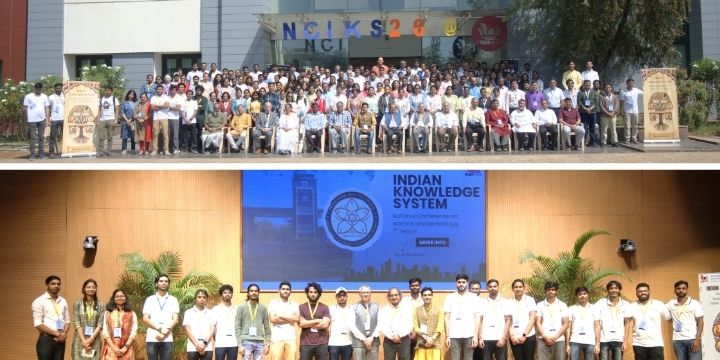
Organizing Committee
Faculty Members
- Prof. Ramakrishna G. Bhat, Department of Chemistry, IISER Pune
- Dr. Rahul Dahiya, Department of Earth and Climate Science, IISER Pune
- Dr. Chandrasheel Bhagwat, Department of Mathematics, IISER Pune
Student Members
- Mr. Jatin Raghuwanshi, Physics
- Mr. Ganesh Kondhare, Chemistry
- Mr. Rana Aaditya Kumar Singh, Physics
- Mr. Aditya Dahiya, Biology
- Mr. Sumit Singh, Biology
With inputs from Prof. Ramakrishna G. Bhat