Links to some of the news articles that have appeared in the media on this work: Hindustan Times, Phys.org, Pudhari (PDF 1.6 MB), Free Press Journal
In a paper published in the journal Small, a team of physicists from IISER Pune developed tiny electronic devices from a special semiconductor material called bismuth oxyselenide (Bi₂O₂Se). This development has potential applications in future flexible smartphones, wearable health monitors, smart fabrics, and bendable electronic gadgets.
As electronic devices become smaller and more powerful, the conventional semiconductor materials used today are reaching their physical limits. This has led scientists in this field to explore a new class of materials called two-dimensional (2D) materials, which are only a few atoms thick, as a potential alternative to existing semiconductors. At just a few billionths of a meter thick, much thinner than a human hair, bismuth oxyselenide (Bi₂O₂Se), is one such material which can make electronic devices faster, more efficient, and more flexible. However, the use of such 2D materials has so far been limited because it is difficult to make them large, stable, fast, and mechanically strong.
In this recent work led by Dr. Atikur Rahman from the Department of Physics, the IISER Pune team overcame these challenges by developing a simple method to grow large, ultra-thin nanosheets of Bi₂O₂Se while keeping them only a few atomic layers thick. Dr. Rahman said this is an achievement that has been difficult in this field, but made possible by the team through carefully optimising key factors such as temperature, gas flow rate, precursor ratio, and reaction time.
Using these nanosheets, the team fabricated microscopic electronic devices that are about a thousand times smaller than a human hair. These devices were built on a flexible, plastic-like surface (Kapton substrate) and tested by repeatedly bending and folding them. The team found that even after thousands of such cycles, the devices showed no loss in their electrical or light-sensing performance.
“This high level of durability is crucial for future technologies such as smartwatches, foldable displays, and wearable medical sensors, where electronic components must remain reliable despite constant movement and strain,” said Dr. Rahman, commenting on the potential applications for the nanosheet devices they developed.
This work received research grant support from DST-SERB. The team included Avinash Mahapatra (PhD student), Sudipta Majumder (PhD student), HL Pradeepa (Post-doctoral researcher), Pawan Kumar Gupta (PhD student), Shrikrishna Bhagwat (PhD student), Shivprasad Patil (faculty member), and Atikur Rahman (faculty member and team leader on this work).
Citation:
Mahapatra, A., Majumder, S., Pradeepa, H., Gupta, P.K., Bhagwat, S., Patil, S., & Rahman, A. (2026). Large‐Area Bi₂O₂Se Nanosheets With Enhanced Optoelectronic Performance for Flexible Electronics. Small. https://doi.org/10.1002/smll.202510537
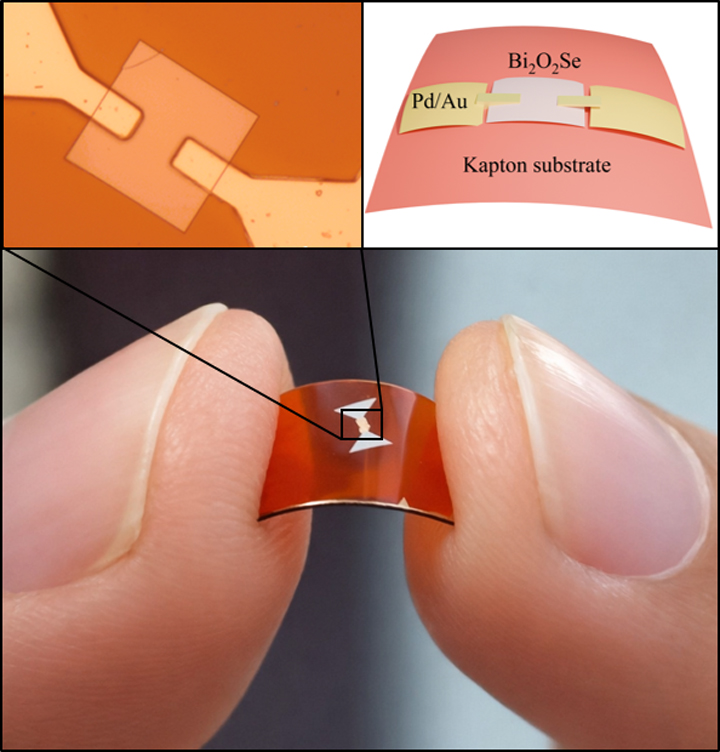
- with inputs from Dr. Atikur Rahman